If you’re a homeowner in New Jersey weighing your refinancing options, you’ve probably run into two terms that sound similar but work very differently: cash-out refinance and rate-and-term refinance. Both let you replace your current mortgage with a new one, but the reasons you’d choose each — and the financial outcomes — are not the same.
This guide breaks down the cash-out refinance vs rate-and-term refinance decision in plain language, with a specific eye on what matters for New Jersey homeowners: property taxes, home equity trends, and local lending rules. If you haven’t already, start with our cornerstone guide, Mortgage Refinancing in New Jersey: Complete Guide for 2026, for the full picture on timing, costs, and the refinancing process from start to finish. This article zooms in on one of the most common forks in the road.
What Is a Rate-and-Term Refinance?
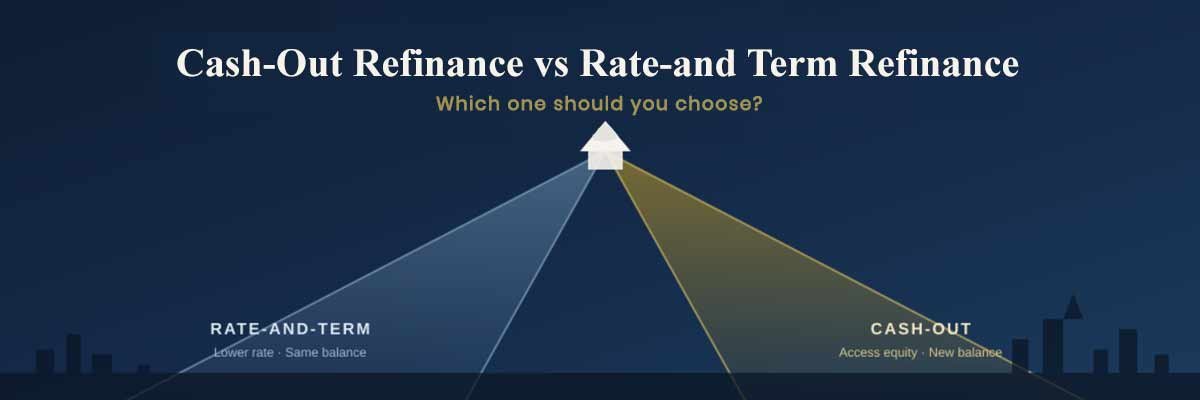
A rate-and-term refinance replaces your existing mortgage with a new loan that has a different interest rate, a different loan term, or both. No cash changes hands beyond covering closing costs and paying off the old loan. Your loan balance stays roughly the same (aside from fees rolled in).
Homeowners typically choose this route to:
- Lower their monthly payment by securing a better interest rate
- Shorten their loan term (say, moving from a 30-year to a 15-year mortgage)
- Switch from an adjustable-rate mortgage to a fixed rate for more predictability
- Remove private mortgage insurance (PMI) once enough equity has built up
Why NJ Homeowners Lean Toward Rate-and-Term Refinancing
New Jersey carries some of the highest property tax burdens in the country, so even a modest reduction in your mortgage rate can meaningfully ease monthly housing costs. For homeowners in towns like Montclair, Cherry Hill, or Edison, shaving even half a point off a rate can translate into real monthly savings without touching your home’s equity.
What Is a Cash-Out Refinance?
A cash-out refinance also replaces your existing mortgage, but with a larger loan amount than what you currently owe. The difference is paid to you in cash at closing, based on the equity you’ve built in your home.
This option makes sense when you want to:
- Fund a home renovation or addition
- Consolidate higher-interest debt, like credit cards or personal loans
- Cover major expenses such as tuition or medical bills
- Invest in another property
Home Equity Trends Make Cash-Out Refinancing More Common in NJ
Key Differences Between Cash-Out and Rate-and-Term Refinance
| Factor | Rate-and-Term Refinance | Cash-Out Refinance |
| Loan balance | Stays about the same | Increases |
| Cash received | None | Yes, based on equity |
| Primary goal | Lower rate or change term | Access equity for spending |
| Interest rate | Often slightly lower | Slightly higher, typically |
| Closing costs | Lower overall loan amount | Based on larger loan amount |
| Impact on equity | Minimal | Reduces home equity |
How Interest Rates Compare
Lenders generally view cash-out refinances as carrying more risk, since you’re borrowing more against the home. Because of this, interest rates on cash-out refinances tend to run slightly higher than rate-and-term refinances. It’s worth running both scenarios with a NJ-licensed loan officer before deciding, since even a small rate difference compounds over a 30-year term.
Which Option Fits Your Financial Goals?
Choose a rate-and-term refinance if:
- Your main goal is a lower monthly payment
- You want to pay off your home faster
- You’re refinancing out of an ARM before it adjusts
- You don’t need extra cash right now
Choose a cash-out refinance if:
- You have a specific, valuable use for the funds (renovation, debt payoff, investment)
- You’ve built substantial equity, especially given NJ’s strong home value growth
- The new rate still makes financial sense compared to alternative borrowing options
- You’re comfortable with a larger loan balance in exchange for liquidity
A Quick New Jersey Example
Costs and Considerations Specific to New Jersey
How to Decide: Questions to Ask Yourself
- Do I need extra cash, or do I just want a better rate?
- How much equity have I built, and how has my home’s value changed?
- Will the new rate still save me money once closing costs are factored in?
- How long do I plan to stay in this home?
- Does my current loan have PMI I could eliminate?
Both cash-out and rate-and-term refinancing can be smart financial moves for New Jersey homeowners — they simply solve different problems. A rate-and-term refinance is about optimizing what you already have: a better rate, a shorter term, or more predictable payments. A cash-out refinance is about putting your home’s equity to work for a specific goal.
Understanding the cash-out refinance vs rate-and-term refinance decision is just one piece of the larger refinancing process. For a complete walkthrough of timing your refinance, understanding NJ-specific costs, and preparing your application, read our full guide: Mortgage Refinancing in New Jersey: Complete Guide for 2026 (When, Why & How to Refinance).
Ready to see which option makes sense for your situation? Connect with a Faster Mortgage loan officer today for a personalized rate comparison based on your home’s current value and your financial goals.